Saturday, May 17, 2014

Energy Costs and Land Use

Every time that I see an article about energy costs, it makes me glad that I live in a city.  I predict that my energy usage is probably less than 25% of a normal Americans.  Why, is it because I change my everyday life to live without?  Nope.

Living in shared space (an apartment / condo) in a larger building is inherently energy efficient.  Even more so if there is shared heat / water.  The fact that I don't need a car means that there is no car payment, no oil changes, no need to buy gasoline.  That's the benefit to walking.

So, for the city dweller, a change in energy costs means next to nothing.  For Joeanne Six Pack heating and cooling her exurban McMansion and driving everywhere, well, a small change means big hurt.

Friday, May 16, 2014

Transportation Tuesday: Nitschmann Middle School Parking

Last week, the Morning Call had an interesting opinion piece from the forever hard-nosed Paul Carpenter about a parking situation developing over at Nitschmann Middle School.  Apparently, the School District is doing some renovations at the school that will require that part of the existing parking lot is torn up and made unusable for parking.

The current solution to the problem will be to open up areas of the Bethlehem Rose garden for parking.  In the process several large trees will be removed and teacher's cars will be parked in the garden.  Carpenter, channeling his inner Joni Mitchell, disapproves of the idea.

Initially I though that Mr. Carpenter was (as he is sometimes prone to do) overreacting, but the thing just stuck in my craw.  Then, I realized why.  Tearing up a beautiful (and well used) rose garden to accommodate parking is just one more concession that our cities are asked to make in favor of the car.  When are we going to stop and say to ourselves, hey, we are serious when we say that our community should be walkable.  We are serious that walking, biking, and shared transportation should be the first things that come to mind when we are confronted by a transportation problem.

Martin Tower (and its large surface parking lots) is less than half a mile from the middle school.  What is the harm in asking the teachers to walk (or if the school district wants to---run a shuttle).  I walk a mile or so a day to get to and from my home to work.  It keeps be slim.  My grandmother walked everyday from 9th and Tilhman to 7th and Hamilton to get to her job.  And, I bet a lot of the middle school kids have to walk even further to get to school.  Why is it that once you become a teacher you shouldn't have to walk a mile in the kids' shoes.  These are the people setting the example for how we ought to be living in our communities and that example ought to include walking for the sake of the community and health.
I know that this seems like a small thing, but every single time our cities are asked to chose between walking or a car they are pressured into accommodating the car.  Its time to stop it.  And its time to say publicly---that's it, the era of the car-centric city, is at an end.  We are serious about sacrificing a bit of car comfort to make our city more beautiful, more walkable, and healthier.  I hope that city council takes action against the destruction of the rose garden and clearly says why the car in no longer king in Bethlehem.


New Allentown Video

Sure, its a fluff piece, but it looks great!


https://www.youtube.com/watch?v=mnfXEjUl2kc

Changing Landscape of Valley Real Estate Development

Suburban Death
This article is exactly what the new urbanists have been saying for years---what we need is more housing, but in already existing neighborhoods.  This necessarily means more mixed use, more density, and more walkability.  It means refocusing attention into the downtown because that is where these goals can be more easily realized.  It is absolutely amazing to see real estate professionals in the Valley finally talking about non-suburban models of growth.


Molovinsky on Minorities


Mr. Molovinsky has another interesting piece ostensibly about race politics today. As has been the constant refrain for years now, opponents of the downtown redevelopment are claiming that the NIZ is a tax grab that takes money out of the hands of minority residents and funnels it to wealthy developers and business people. At the same time, Mr. Molovinsky constantly opines about the "glory days" of Allentown. he loved when the community came together through the CCC to improve the city parks. He waxes nostalgic about the trolleys and shopping on Hamilton Street. Fine, but, you can't really have it both ways.

Allentown was once a great city because people from all classes pulled together. Through successive waves of immigration in the nineteenth and early twentieth century, older majority population groups (first the English and Germans) stayed in the city and continued to pay property taxes and maintain communal institutions as new immigrants from Southern and Eastern Europe arrives. Its not like there wasn't friction---there was. But, by and large, Allentown became a thriving city because different ethnic groups and races were able to coexist and largely pull together.


Fast forward to the 1970s and 80s and the middle class abandoned Allentown to head to "greener pastures" in the `burbs. They took with them their money and their public institutions. Without property taxes and without people who cared about community institutions, Allentown withered on the vine.

Now, because of the NIZ, we start to have a nascent migration back to the city. We start to have money coming in, and we start to have middle class people regaining a consciousness of place. These are the steps to redeveloping the economic foundation of the city. And with that foundation secure, all ships (all races and classes will rise). The process won't be perfect there will be some friction around the edges, but Allentown needed a shot in the arm. Mr. Molovinsky is always championing for the status quo---that status quo has kept Allentown's head under the water for four decades. And yet, he also recognizes that the town once had greatness. And, it is obvious that he longs for that greatness once more. It is impossible to reconcile both good things without some friction.

Thursday, May 15, 2014

Molovinsky Scoops the Food Desert

In a great post today, Molovinsky has scooped the fact that downtown Allentown's food desert may be coming to an end.  While I can't provide any independent verification of this fact, if true, it is absolutely great news for the neighborhood.


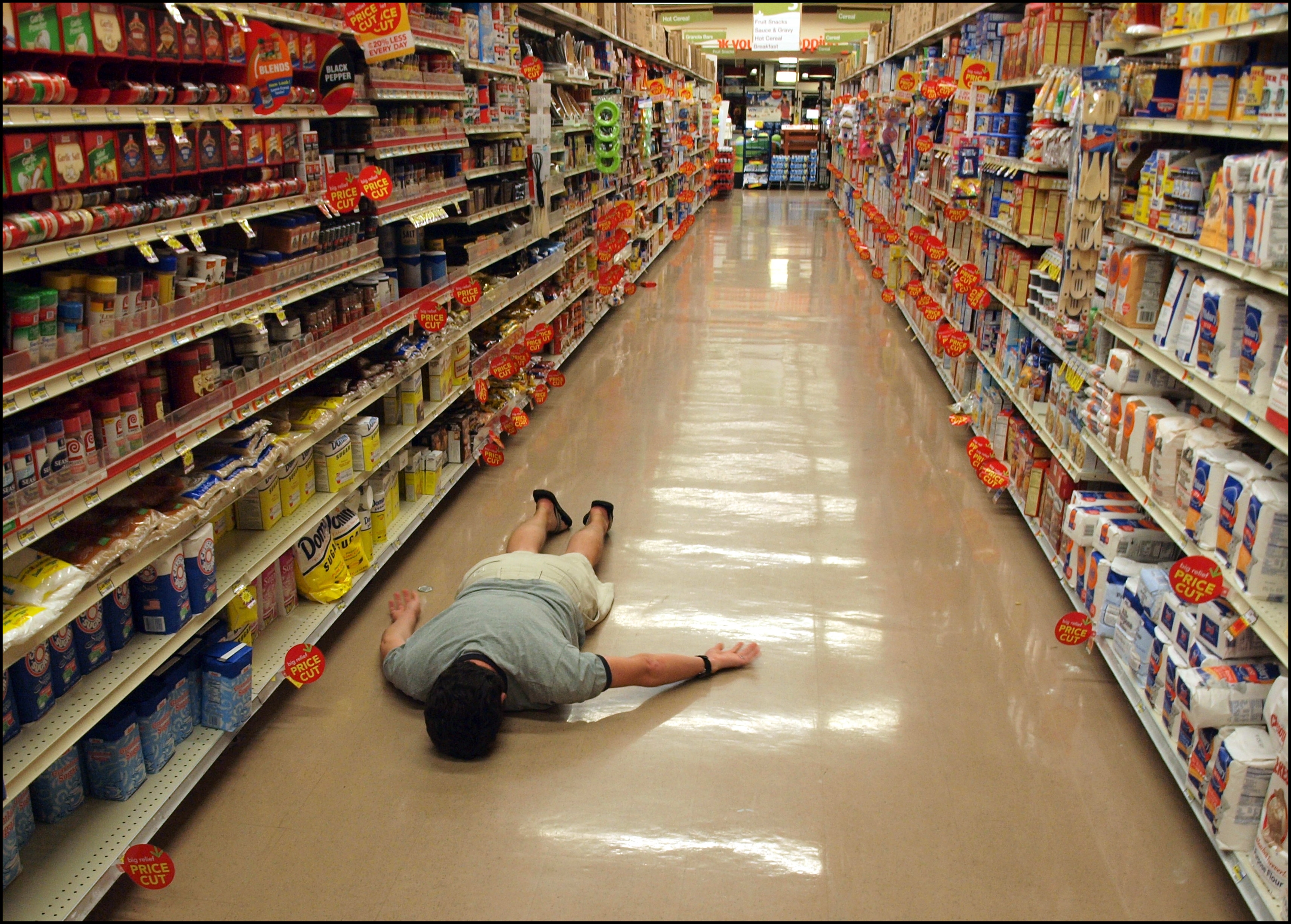
Existential Suburban Supermarket
As many readers know, I am often deeply at odds with the way in which Molovinsky try's to achieve his policy goals, but, you can never doubt his conviction that Allentown government policy ought to serve the working class and that is where his concern for the market arises from.

There might be no greater example of the fact that urban areas are going through a renaissance than the fact that food markets are once again opening up in them.  It is one of the saddest and most shameful moments in the middle-class flight to the 'burbs that the basic institutions of life were drawn out of cities.  These included things like grocers, clothing stores, hardware shops and all the rest of it.  But, the worst, from a human point of view was the loss of places to buy quality foods.

The result are vast areas of urban America that are only served by fast food restaurants and (possibly) bodegas that sell the worst kind of processed food crap.  Buying a head of lettuce might require several hours on a bus with multiple changes.  Before anyone moralizes about this fact, ask yourself, when was the last time I put in three hours of effort for a salad?
Old Time Downtown Market


One of the best things about living in a city is that you don not need a car to accomplish the daily things of life.  In fact, a lot of urban designers define cities by this metric:  can you reasonably (about 10 minutes) walk or ride a bike to the daily activities of life.  If the answer is no, you may have density but still lack a functioning city.  The opening of this market in Allentown and the Bethlehem Food Cooperative in Bethlehem show that middle class folks are once again focusing their attention into the downtowns.  They want actual workable cities---not just density.

Finally, one last observation.  What brought this supermarket into the downtown?  It was the NIZ.  Molovinsky claims that the rite aid used to serve the purpose of a market, that is ludicrous.  I have worked downtown for many years and knew that Rite aid well.  There were bags of candy and sports drink---not much else. THE NIZ, with its thousands of well payed workers are the ones with the money to create a demand for a market.  Money begets money and what Allentown has needed for a long time is a critical density of wealth to spur more and more development.  The NIZ has kick started that sort of development.  And this market is a great indication of how the government's investment is helping the little guy.

Wednesday, May 14, 2014

Jon Geeting on Eliminating full stops for Cyclists

Making a twenty pound bicycle obey the exact same road rules as a two ton piece of machinery, a.k.a. an automobile is ridiculous.  No one in their right mind would set down to draft the same set of road laws for both bicycles and cars.  And, yet, through, habituation people have come to expect bikes to follow the same rules.  The result is that when bicyclists "break" the law safely (or for their own safety) they are criticized by yahoo motorists who think a violation of a ridiculous crime ought to carry moral approbation.  Stupid.  Jon Geeting has more on legalizing the rolling stop for bicyclists at this old city.

Also, check out this video by a real American hero.