Showing posts with label suburbs. Show all posts

Tuesday, May 20, 2014

Transportation Tuesday: the Rosegarden and LVCI Doubling Down on Stupidity

A quick note about the concept of Transportation Tuesday.  I think that by any measure, any sane person would admit that the non-car transportation infrastructure in the Lehigh Valley is absolutely attrocious.  Not only that, but virtually nothing has been done to improve that fact.  This while cities all over the U.S. are preparing for a time when the car will no longer be king.  For reasons of consonance, I am picking Tuesday to browbeat public officials about the fact that they ought to be making better transportation choices.

Enough said about the philosophy, lets talk politics.  This week's Transportation Tuesday post considers the news out of West Bethlehem that the city is about to bulldoze under part of the rose garden to make room for a temporary parking lot for a middle school.  Are you fucking kidding me?!  Martin Towers and its massive parking lots are less than a mile from the site that this about to happen.  Why not make the teachers park at Martin Tower and walk in.  Hell, the kids walk further than that to get to school.  Here is my whole article about the situation.  Like it or not bulldozing under the rose garden for a temporary parking lot is the type of trade off you have to make when you run a town where you value the car more importantly than any other mode of transportation.  There can be no clearer and more causal link of cars destroying public space and undermining urban aesthetics than BULLDOZING A ROSE GARDEN to make way for a PARKING LOT.  Dumb.  And this from a city that calls it self the most walkable in the Valley.  Jokes.
Bike Infrastructure in Europe.

And then there is this from the ever assinine LVCI:  Urbanologists without Cars.  In a bit of crack reporting, LVCI runs down all the ways in which it is inconvenient to live in the Valley without a car.  No shit? tell us more!  From this he concludes that we should double down on car infrastructure.  Whoaaa there Spartacus.  Us "urbanologists" want to change the development patterns so that a car is not required.  We want to live in a downtown where there are parks, and vets, and doctors, and all that stuff you mention in walking distance.  That is our promised land.  We don't have that now because people like LVCI thought it would be good to structure the world in such a way that you NEEDED a car to get to essential services.  Good (maybe) if you are wealthy an live in the 'burbs.  Bad if you are poor and in a city and need access to stuff like, I don't know, food.  My grandparents, (probably like LVCI's) lived in Allentown and they got along fine without a car.  This isn't some mythical utopia we are vying for, just a workable city that existed pretty well in Allentown for a long time.

Monday, May 19, 2014

What Social Equality Looks Like to Millenials

A few days ago, someone in the comment section accused this blog (and Job Geeting) of asking big government for a hand out.  That's absurd.  As I replied, this blog (and Jon Geeting's which proceeded it), is largely premised on the fact that government ought to deregulate the housing market by stopping absurd subsidies to wasteful suburbs.  That is exactly what has happened in Allentown.  As I pointed out yesterday, Allentown has created a real estate free market where tax money flows back to developer to be used to finance the construction of new real estate.  That and minimal zoning restrictions has allowed Allentown to amass nearly a BILLION dollars of real estate investment.  Like I said, Allentown should be the wet dream of free market republicans and the libertarians.

What does this have to do with social equality?  Well, a strong case can be made that starting in the 1950s, the federal government and states undertook a conscious effort to segregate minorities in cities from the Lilly white suburbs.  If you read the transcripts of the senate debate about the mortgage interest tax deduction, Southern Democrats actually note that a benefit of the program will be to help middle class white folks escape "animals" in the cities.  Yikes, (bad quote isn't it Bernie? lol).  The fact is that the suburbs received TRILLIONS of dollars of tax subsidy over the years in a process that was meant to segregate a white middle class suburban majority from minorities who were to be left in cities.  Don't believe me, try to remember how the media depicted cities in the 1980s, you know when Philadelphia fire bombed a residential block or the film "Escape from New York."
Oh look, a black guy with a gun and a chain.

Now, I will concede that there were social programs around the edges to try to help populations left in cities.  But, here is the thing, I think most millennials are willing to concede that in many cases, government programs are ineffective.  Social programs are often a band aid over a much, much larger cultural problem.  What was that problem in America---it was racism that led to an incredibly unfair housing policy that sent middle class folks to the suburbs with their money and their cultural institutions.  The cities were left to rot with strongly derided "social programs" providing a modicum of relief.  When these social programs failed, the middle class sneered even harder form their suburban fiefdoms.

How to fix the problem?  Ronnie Reagan maybe got something right, maybe, sometimes government is the problem.  That is why Allentown's free market, zoning-light NIZ district is such a big deal.  For the first time, in a long time, it is encouraging people to come back to the city.  It is only when the middle class returns to Allentown, with their tax money and philosophy of stable civic organizations, that things are going to turn around for everyone in Allentown.

This is not to say that millennials are some sort of uber-generation bent entirely on social equality.  They want cities because cities are cool and interesting places to live.  But, here is the thing, they don't demand a lilly white playground like the suburban white flightiers before them.  And because of that single important fact everyone's ship in a city will rise.  By ignoring race and class, rather than dwelling on it, the millenials will do more for everyone than the previous generations could even dream.

Sunday, May 18, 2014

Its Official: One Billion Dollars of Development

Its hard to know where to start on an article like this.  The idea that Allentown, Pennsylvania could have brought in nearly a billion dollars of investment money even five years ago would have been laughable.  The city was on the ropes.  Not anymore.  Now Allentown is the place to be, its the place to go out, and pretty soon it is going to be the place to live.

The first place to start might be to address some of the negative criticisms.  There are a lot of questions about what will happen after the NIZ run outs.  First off, that is a long way down the road.  The NIZ is in place for 30 years and will drive development during that entire time.  Why?  First, you need an explanation of how the NIZ works.  The law is complicated, but essentially this is how it goes:

1.  NIZ taxpayers pay their rent as normal.

2.  That local and state taxes are sequestered at the state level and returned to the ANIZDA board.

3.  ANIZDA uses the money to pay off the construction loans of the new development.

When you zoom out, what the NIZ is really doing is creating a free market, it is saying, if you build within the geographical boundaries of this zone, you can use your own money to finance the construction of your own building---the state will bow out of the market.  That's smart.  That's a free market---that what hardcore Republicans and libertarians have been gunning for for years.  People like J.B. Rilley couldn't compete with all the tax breaks and incentives that had previously been going to the 'burbs, but, because Allentown now has a free market, he (and other developers can compete).

The consequence:  ONE BILLION DOLLARS in investment.  The best part is, there is no way the tax payers are left holding the bag.  Once the NIZ ends, tax revenue is returned to the state---the new real estate development should be totally financed by that point.

Once again, this is a huge win for Allentown.  Haters are gonna hate but they are now in the minority.  My generation, the millennials, want vibrant cities.  For all we care, the strip malls of suburbia and McMansions ought to decay into dust---it would look better anyway.

Great job Allentown.

Tuesday, May 13, 2014

Hegel, Alienation, and America's Loss of Place

A few years ago I was at an event with the then mayor of Whitehall.  The mayor lamented to me, saying, "I don't understand it, why does everyone talk about Allentown, Bethlehem, and Easton in the same breath?  Why don't they mention Whitehall, we have more people than Easton!"  Half jokingly, I replied, "people might not think about Whitehall because its basically a three mile strip mall.  What else are you known for?"
Walmart in Whitehall


I tell this story to express a point.  In America, we are conditioned to think of social importance as emerging out of population numbers.  The more people, the greater the importance.  This might be true in a purely political sense, but, it does not capture how we actually think about social importance.  What is really important about social importance is perception.  For example, in the 17th century, the ideal of female beauty was much different from how it is today.  In that period, a curvaceous almost overweight figure was preferred.  Rotundity bought social cache.  Today, the opposite is true.  "Beauty" is not a fixed concept, it changes with what we use to talk about the ideal.

The same is true of population centers.  In an ontological sense, a populated place is just a collection of bricks and mortar and streets.  It assumes no identity until we start to tell stories about the place.  And, here, is where the cities of Allentown, Bethlehem, and Easton begin to take on an important role in our imagination.  Growing up, my parents would tell me great stories about the halcyon days of Allentown.  When kids would go ice skating down at Union Terrace then then buy a hot dog at Yaccos.  The pride of the entire city going to a football match at the ASD stadium.  Shopping on Hamilton Blvd. and Hess's.  Walking to the fairgrounds and randomly meeting family and friends that stretched back to elementary school.

That was Allentown.  It had a character.  People talked (and still talk) about the character.  Despite my many misgivings about Mr. Molovinsky's ideas, his Romanticized rhetoric about the city is why I still respect him.  By contrast, you might ask, what do people say about whitehall?  There is a generic 1980s mall there.  What historical events happened there?  None that I can think of.  The place is a three mile strip mall, not much more.  Now you might say, yeah, but people live there.  People have individual memories in their own home.  True, I don't deny that.  But, when people don't interact, when they don't share communal institutions, group identities are not created.  And, the lack of a group identity ultimately leads to great swaths of this Commonwealth living alienated and isolated consumer driven lives.

Alienation is a hash word, but, its a pretty good description of early 21st century America.  It is the America inaugurated by Vonnegut and described in cruel detail by David Foster Wallace.  It is an America of the individual consumed by herself, her own needs, and her own entertainment.  It is a world, frankly, given over completely to the individual and the ego.  It is a world that tends toward the skeptical and the nihilistic.


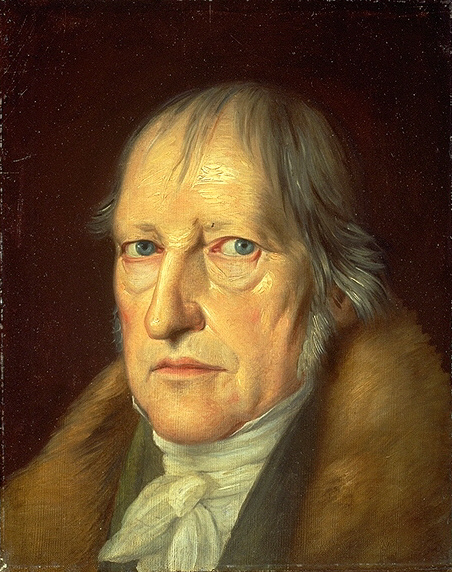
G.W.F. Hegel

It is a world, however, that is not necessarily new or entirely modern.  Following Kant's "Copernican Revolution" many early 18th century German philosophers attempted to confront the idea of how to escape nihilism in a world devoid of God and constituted by individual consciousnesses.  The most successful of these German philosophers was Hegel.  Although his entire philosophical project is incredibly difficult and dense it boils down to a few main points, the most important of which is this: none of us is entirely free to determine everything in our own life, the way in which we perceive the world is colored by the community in which we live.  Happiness, freedom, and an escape from nihilism is obtained in living one's life in accordance with the spirit (identity) of the community.

Now, that might sound absolutely un-American, but, I don't think that it needs to be.  As an American, we have the right to live where we find a community that corresponds with our internal values.  And, we ought to be able to find distinctive communities that to a greater or lessor degree fit who we are.  Maybe, that place is Allentown, maybe it isn't.  But, for the vast, vast, vast majority of people, that place is not going to be the uniform blandness of the suburbs.
Roosevelt visits Allentown Speaks to Throngs of Citizens

Cities need to be given the chance to grow and develop distinct identities because it is only within an identity of place that individuals can also find their own purpose and connectedness.  We have tried the suburban model, it doesn't work.  Political communities must be more robust---there must be more shared institutions and interactions.  Until we overcome this problem of lack of sense of place Pennsylvania (and America) will continue to suffer from an anxiety of purpose and narcism of character.  Redeveloping mid-sized urban space would go a long way to solving these types of problems.